
Gala Flamenca 2026
Eva Yerbabuena, Gala Flamenca © Laura León
For the last 25 years, Sadler’s Wells has hosted The Flamenco Festival, a dedication to one of Spain’s most famous cultural exports and celebration of its musical and dance performers.
At the heart of the Festival is the Gala Flamenca, which brings together some of the world’s leading Flamenco performers for a one-night spectacular. For my first foray into Flamenco, the opportunity to witness such legends, including Olivier Award-winner Eva Yerbabuena and London regular Manuel Liñán (who also directed the gala), in one night felt like the perfect place to begin.
I mentioned that this is a celebration of Flamenco both dance and musical and the music is where we shall begin. For if I learnt anything, it is how interwoven the two sides of this art form are. Our four Flamenco dancers gave their all alongside four powerful singers, two guitarists and a drummer, who sat alongside them as both observers and participants. The singers at one point followed one dancer (rising star Juan Tomás de la Molía) as if he were the Pied Piper, while later a singer burst out into dance herself, the emotions of the score too much to portray through song alone. As they sat in a semi circle as observers to the dance, the art form’s history was really felt. Their rasping tones transported us to a sweltering evening as the sun set and villagers created their own entertainment through dance and song. It was like taking Flamenco back to its Andalusia origins.
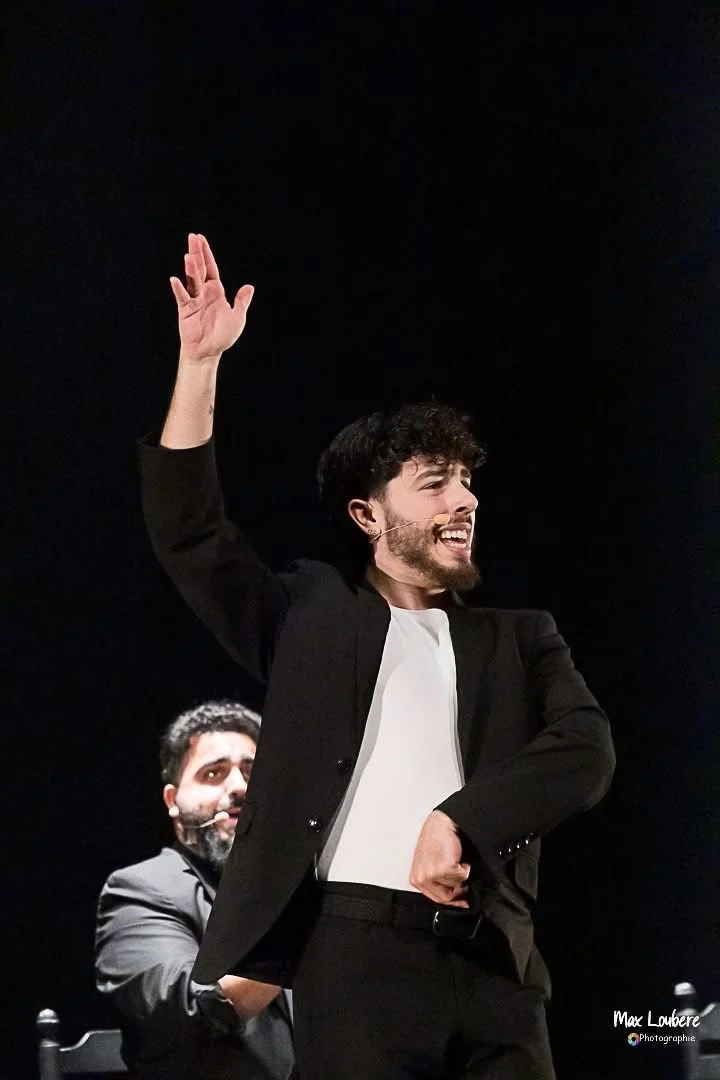
Juan Tomás de la Molía, Gala Flamenca © Max Loubere
And so to the dancing. Unlike a traditional start-stop ballet gala, this was a more flowing affair, with an opening and closing group number, dance offs and the movement between one piece and the next highly choreographed. It was one big show rather than a selection of showcases and all the better for it.
The night, directed by dancer Manuel Liñán, showed the various tones and flavours of Flamenco performed today. Through the evening, by watching dancers with varying interpretations and lengths of time in the industry, I began to understand what makes Flamenco tick and the various ways in which it has developed. Here are a few things I observed.
Flamenco is both constrained and unconstrained. Dancers are often held captive in a single spot as their feet tap mercilessly underneath them, creating more beats than your eyes can keep up with. But that doesn’t make their performance insular. Their arms shape around their body, the men strip their blazer off a shoulder, a scarf is whipped around the body, a skirt hem is lifted, a wrist is twisted. They also strut and move around the stage, or perform in duets, including a semi dance off between Olivier Award-winner Eva Yerbabuena and Liñán.

Manuel Liñán, Gala Flamenca © Marcos Gpunto
However, Flamenco is often a solo performance, meaning the dancer needs to have massive stage presence in order to hold their audience captive. Newcomer de la Molía held our attention with a knowing look and brash confidence, while Liñán's cheeky demeanour (led with an expressive mouth and glint of the eye) proved why he’s a London favourite. The use of body percussion enhanced their confidence, with claps of the hand and smacks of the legs and torso adding to the build up of a phrase’s energy, which was then released in moments of triumph eaten up by the audience.
Liñán also presented a fascinating mix of the traditional and the new. He was a male dancer blending with the feminine through dance style and dress. Interestingly, he sported the most traditional outfit of the night: the famous bata de cola skirt. This long flounce of fabric was expertly manipulated by his legs as he effortlessly tossed this additional obstacle out of the way or hitched it onto an arm to tease a glint of knee beneath. On top of this, he wrapped and unwrapped a large shawl around him, the fabric an obedient servant to its master: never tripping him up, always winding the right amount. I’d never thought much about costume-ography until this point as a dance writer. I will now.
Flamenco is a heritage art form. It originated in the 18th century and it was declared a Masterpiece of the Oral and Intangible Heritage of Humanity by UNESCO in 2010. What I found most riveting was how you could feel the weight of this heritage through the night. From the rasp of the singers voices and strum of the guitar, through to the presence of dancer Antonio Fernández Montoya ‘El Farru’, ‘a key figure in the legendary Farruco dynasty’ who started performing at six years old following in the footsteps of his parents and grandfather, ‘the great Farruco’. How many other dance styles have a ‘dynasty’?!
While in places the night dragged a tad (Flamenco does have a formula, to an extent), the Gala Flamenca was a brilliant introduction to, and celebration of, the world of Flamenco and its stars. I can’t wait to see what this Flamenco adventure has in store for me next.
★★★★
Gala Flamenca
Performed by Eva Yerbabuena, Manuel Liñán, Juan Tomás de la Molía and Antonio Fernández Montoya
Sadler’s Wells, London / 19 June 2026
Press ticket
Find your next dance show
All dance shows happening across the UK, all in one place. Only on Like Nobody’s Watching.
Check out these related reviews


🪩 Brought to you by Like Nobody’s Watching
